
Kimi AI is a product and model brand created by Moonshot AI, a privately held artificial intelligence company founded in Beijing in 2023. Kimi is not a separate publicly traded company, and Alibaba does not solely own it. Moonshot AI is owned by a group of founders and outside investors, but no complete current public cap table shows every shareholder and voting arrangement. Yang Zhilin is the founder and CEO most closely associated with the company. The legal entity named in your contract can differ by product and region: current international consumer terms name NOVASCENT PRIVATE LIMITED, while the international API terms name Moonshot AI PTE. LTD.
Moonshot AI remains privately held, and its ownership percentages may change through new financing, restructuring or a future public offering. Historical investor percentages should not automatically be treated as current fully diluted ownership.
There are three answers to “Who owns Kimi AI?”
Product answer: Moonshot AI created and operates Kimi.
Contract answer: the legal service provider depends on the product and region.
Shareholder answer: Moonshot AI is privately owned by founders and outside investors; its complete current cap table is not public.
Kimi AI Ownership Map at a Glance
| Product or brand | Kimi |
|---|---|
| Company behind the product | Moonshot AI |
| Company origin | Beijing, China |
| Founded | 2023 |
| Founder and current CEO most prominently identified | Yang Zhilin |
| International consumer contracting entity | NOVASCENT PRIVATE LIMITED, Singapore, under the current English Terms |
| International Open Platform entity | Moonshot AI PTE. LTD., Singapore |
| Mainland-China entity named in current Kimi privacy documents | Beijing Moonshot Technology Co., Ltd. and its affiliates |
| Corporate status | Privately held; not currently publicly traded |
| Major publicly reported investors | Alibaba, Tencent and multiple private investment firms |
| Does Alibaba solely own Kimi? | No |
| Does publishing open model weights transfer ownership of Kimi? | No; use remains governed by the applicable model license |
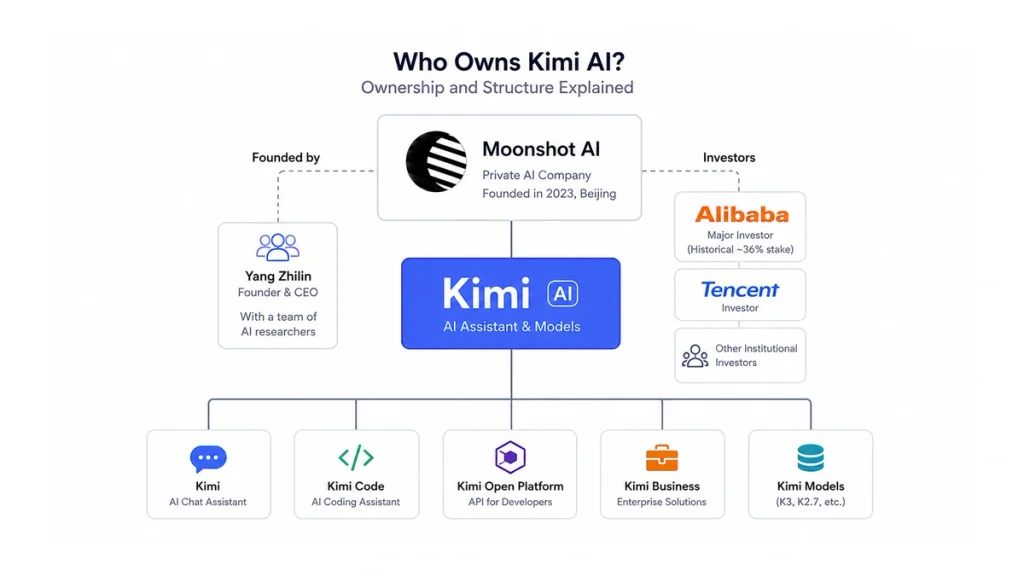
Kimi Is a Moonshot AI Product, Not a Separate Company
People often say “Kimi AI” as though it were the registered name of a company. In practice, Kimi is the user-facing product and model brand created by Moonshot AI.
Moonshot AI is the corporate and research organization. Its official company site places the following products within one portfolio:
- Kimi, the consumer AI assistant.
- Kimi Open Platform, the developer API service.
- Kimi Code, the coding-agent product.
- Kimi Business, the team and enterprise workspace.
- Kimi models such as K3, K2.7 Code and K2.6.
This distinction matters when answering company-level questions:
- Moonshot AI has founders and shareholders; Kimi as a product does not have a separate shareholder list.
- Moonshot AI raises investment; the Kimi chatbot does not raise capital independently.
- Moonshot AI owns or licenses the technology and brand rights used to provide Kimi.
- Kimi model weights can have separate licenses without becoming a separate company.
For model information rather than corporate ownership, see our Kimi API models comparison and Kimi K3 guide.
The Legal Entity Depends on Which Kimi Service You Use
A product can be developed by one corporate group while different group entities provide contracts, billing or data-control functions in different markets. Kimi’s current official documents use several legal names.
| Service or scope | Entity named in current official documents | What that means |
|---|---|---|
| International Kimi consumer service | NOVASCENT PRIVATE LIMITED, registered in Singapore | The current English consumer Terms identify it as the contracting party and call it “Moonshot AI” |
| International Kimi consumer privacy | NOVASCENT PRIVATE LIMITED | The current global Privacy Policy identifies it as the provider and controller of the Services |
| International Kimi Open Platform | Moonshot AI PTE. LTD., Singapore | This entity enters into the API agreement with developers and businesses |
| Mainland-China Kimi products | Beijing Moonshot Technology Co., Ltd. and affiliates | Current Chinese privacy and regulatory documents identify the Beijing entity as the local operator |
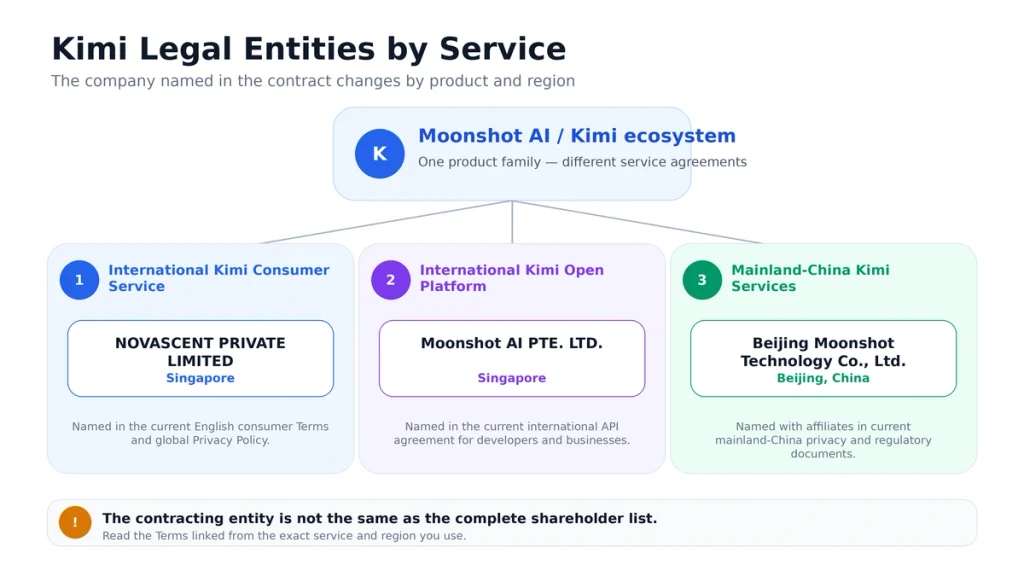
The presence of several entity names does not mean that three unrelated businesses independently own copies of Kimi. It means users should identify the exact entity shown in the terms for the service, account and region they use.
For example:
- A consumer subscription dispute may be governed by the entity named in the consumer Terms.
- An API customer has a separate agreement with the Open Platform provider.
- A mainland-China account can be subject to local Kimi documents and Chinese law.
- The corporate origin of Moonshot AI remains Beijing even when an international contract uses a Singapore entity.
Contracting entity is not the same as ultimate shareholder. A Terms of Service page tells you which company is providing that service to you. It does not reveal the complete ownership of the wider Moonshot group.
What Is Moonshot AI?
Moonshot AI is an artificial intelligence company and research organization founded in Beijing in early 2023. Its official company page says its technical team includes contributors to technologies such as Transformer-XL, RoPE, Group Normalization, ShuffleNet, MuonClip and Mooncake.
The company develops:
- Foundation and multimodal AI models.
- Consumer AI assistants.
- Coding agents.
- Research and knowledge-work tools.
- Developer APIs.
- Open-weight models and research releases.
Moonshot describes its broader research mission as finding an effective way to convert energy and computing resources into intelligence, with work directed toward advanced general-purpose AI.
The official company address is currently shown in Beijing’s Haidian District, one of China’s main technology and research centers.
Who Founded and Leads Moonshot AI?
Yang Zhilin is the founder and CEO most prominently identified with Moonshot AI. He studied at Tsinghua University and completed a PhD at Carnegie Mellon University. His earlier research included work on Transformer-XL and XLNet, technologies associated with improving how language models process long-range context.
This background helps explain why long-context processing became one of Kimi’s earliest product themes.
Reputable profiles consistently identify fellow Tsinghua alumni Zhou Xinyu and Wu Yuxin as co-founders or core founding members. Some detailed profiles also identify Zhang Yutao as part of the core founding team and later technical leadership.
Why do Moonshot AI founder lists sometimes differ?
Private startups do not always publish one permanent public list distinguishing among:
- Legal founders shown in incorporation records.
- Business co-founders.
- Core founding technical employees.
- Early executives who joined before the public launch.
The safest wording is that Moonshot AI was founded by Yang Zhilin and a team of Tsinghua-connected AI researchers, with Zhou Xinyu and Wu Yuxin consistently named in reputable public profiles.
Without current corporate filings or a public prospectus, an article should not invent an exact founder-equity table.
Who Owns Moonshot AI?
Moonshot AI is a privately held company. Its ownership is distributed among:
- The founding team.
- Employees or executives who may hold equity or options.
- Early venture-capital investors.
- Strategic technology investors.
- Investors that participated in later private financing rounds.
A complete current capitalization table is not publicly available. Therefore, it is not possible to verify from public materials:
- Every current shareholder.
- Each shareholder’s fully diluted percentage.
- Current voting-right allocations.
- Board appointment rights.
- Preferred-share protections.
- How later rounds diluted earlier investors.
Anyone publishing a precise current pie chart of Moonshot ownership should provide a recent company filing, shareholder resolution or prospectus. Without one, the chart is an estimate rather than a verified cap table.
Does Alibaba Own Kimi AI?
No. Alibaba is a major investor in Moonshot AI, but Kimi is not an Alibaba-owned product in the same sense that Qwen is an Alibaba model family.
Alibaba disclosed that during its fiscal year ended March 31, 2024, it invested approximately US$0.8 billion for an equity interest of approximately 36% in Moonshot AI.
That disclosure establishes three facts:
- Alibaba made a substantial investment.
- The investment represented a large minority position at that time.
- Alibaba was not disclosed as owning 100% of Moonshot.
It does not establish that 36% remains the exact current fully diluted percentage. Moonshot raised additional capital after the disclosure, and new shares, preferred shares, option pools or corporate restructuring can change economic ownership.
It also does not prove that Alibaba controls Moonshot’s day-to-day product decisions, model behavior, hiring or research strategy. Those rights depend on voting agreements, board rights and shareholder terms that are not fully public.
Accurate wording: Alibaba is a major Moonshot AI investor with a historically disclosed large minority stake.
Inaccurate wording: Alibaba is the sole owner of Kimi AI.
Does Tencent Own Kimi AI?
Tencent has also been publicly reported as an investor in Moonshot AI. That makes Tencent a shareholder or financial backer, not the sole owner of the Kimi product.
Neither Alibaba’s investment nor Tencent’s investment turns Moonshot into a wholly owned subsidiary of either company based on the public information currently available.
The same principle applies to venture funds and other strategic investors: holding shares can provide economic exposure and negotiated rights, but it does not automatically make each investor the operator or creator of Kimi.
Ownership, Investment and Control Are Different
| Concept | What it means | What public sources establish for Kimi |
|---|---|---|
| Product ownership | The company owns or licenses the product technology, brand and service rights | Moonshot AI identifies Kimi as its product |
| Legal service provider | The entity that enters into the contract with a user | Varies between international consumer, API and mainland-China services |
| Economic ownership | Who owns shares and receives economic value | Founders and multiple private investors |
| Voting control | Who can approve corporate decisions | Not fully disclosed through a current public cap table |
| Operational control | Who directs products, staff and research day to day | Moonshot’s founder-led management operates the company; complete governance terms are private |
| Model-license rights | What external developers may do with released weights | Defined separately by each Kimi model license |

This is why the question “Who owns Kimi?” cannot be answered accurately by naming the company’s largest reported investor alone.
Is Moonshot AI Publicly Traded?
No. Moonshot AI remains a private company as of August 23, 2026.
It currently has:
- No confirmed public stock ticker.
- No ordinary shares available through a standard retail brokerage.
- No completed public listing on the New York, Nasdaq, Shanghai or Hong Kong exchanges.
Financial reporting in 2026 has described preparations, restructuring and discussions related to a possible Hong Kong listing. An IPO plan, shareholder proposal or adviser appointment is not the same as a completed listing.
The most reliable proof of a public listing would be an official exchange filing, published prospectus and assigned ticker. Until then, sites offering “Kimi stock” are generally referring to private secondary-market interests, estimates or speculative pre-IPO access.
Do Kimi’s Open Weights Change Who Owns It?
No. Moonshot has published model weights for several Kimi model families, but open access does not transfer ownership of the Kimi company, trademark, hosted assistant or other services.
Open-weight publication means a developer may receive specified rights to:
- Download the model files.
- Run the model on separate infrastructure.
- Modify or fine-tune it where the license permits.
- Build a derivative application under the license conditions.
It does not automatically grant the right to:
- Claim ownership of the Kimi brand.
- Present a third-party product as the official Kimi service.
- Ignore attribution or commercial-use requirements.
- Use Moonshot’s logos or interfaces without permission.
- Own the original model intellectual property.
Kimi K3 and K2-generation models use their own published license terms. Review the exact license attached to the model rather than assuming that every “open” Kimi release uses the same rules.
Who Owns Your Kimi Input and Output?
Product ownership and user-content ownership are separate questions.
The current international consumer Terms state that, between the user and Moonshot AI and to the extent permitted by law:
- The user retains ownership of the Input submitted to Kimi.
- The user owns the Output generated in response.
- Moonshot assigns any rights it may have in the Output to the user.
The same Terms also give Moonshot a license to process Content as necessary to operate, secure and improve the Services, subject to the terms and available training opt-out process.
The international Open Platform Terms use slightly different wording: they state that the customer is responsible for its Content and that Moonshot does not claim ownership of it.
Moonshot still owns the intellectual property in the service itself, including its software, models, interfaces, trademarks, documentation and related technology, except where third-party rights or a separate model license apply.
You can own a generated document without owning Kimi. Ownership of a response does not give a user ownership of the model, source code, brand or platform that generated it.
Why Kimi’s Ownership Matters to Users
1. It identifies the responsible support team
Account recovery, subscriptions, API balances and privacy requests must be sent to the official Kimi or Moonshot team—not to an independent guide, app clone or model marketplace.
See our guide to contacting Kimi support for the current product-specific channels.
2. It determines which Terms apply
A consumer subscription, developer API account and mainland-China account can be governed by different contracts, legal entities and dispute-resolution terms.
3. It helps users assess data jurisdiction
Ownership, service-provider location and data-storage location are different factors. Users should read the exact Privacy Policy linked from the service they use rather than assuming that a Singapore contracting entity means every operation or dataset is necessarily located there.
4. It prevents fake-app confusion
App stores contain unofficial guides and unrelated products that use the word “Kimi.” Verifying the developer and official links reduces the risk of installing a clone or sending credentials to the wrong service.
5. It clarifies investor influence
An investor can provide capital, cloud resources or strategic relationships without becoming the product’s sole owner. Users should separate an investor relationship from claims about who trains the model, operates the service or sets product policy.
How to Verify the Official Kimi Product
- Start from Moonshot AI’s official company website.
- Follow its own links to Kimi, Kimi Code, Kimi Business or Open Platform.
- Check that the mobile-app developer is shown as Moonshot AI.
- For Android, verify the official package name rather than relying only on the app title.
- Read the Terms and Privacy Policy linked from the exact service.
- Do not enter a Kimi password or API key into an independent information site.
- Do not assume that a third-party app offering a Kimi model is operated by Moonshot.
A third-party platform can legitimately offer access to a Kimi model through an API or inference partnership. That makes it a provider of access—not the owner of Moonshot AI or the official Kimi consumer service.
What Is Verified and What Remains Private?
| Question | Status | Answer |
|---|---|---|
| Did Moonshot AI create Kimi? | Verified | Yes |
| Is Kimi a separate publicly listed company? | Verified | No |
| Is Yang Zhilin Moonshot’s founder and CEO? | Verified by current reputable reporting | Yes |
| Did Alibaba disclose a major equity investment? | Verified historically | Yes; approximately $0.8 billion for approximately 36% in FY2024 |
| Is 36% Alibaba’s exact current fully diluted stake? | Not publicly verified | Later financing may have changed it |
| Does Tencent have an investment relationship? | Publicly reported | Yes |
| Who owns every current Moonshot share? | Not public | No complete current cap table is available |
| Who has every board and veto right? | Not public | Current agreements are not fully disclosed |
| Is a Moonshot IPO complete? | Verified | No, as of the review date |
Kimi Ownership Myths and Facts
| Claim | Verdict | Explanation |
|---|---|---|
| “Kimi AI is its own company.” | Misleading | Kimi is a Moonshot AI product and brand |
| “Alibaba owns Kimi.” | Incomplete | Alibaba is a major investor, not the sole owner |
| “Tencent owns Kimi.” | Incorrect as a sole-owner claim | Tencent is a reported investor |
| “Kimi is a Singapore AI company.” | Incomplete | International services use Singapore entities, but Moonshot was founded and is headquartered in Beijing |
| “Kimi is already a public stock.” | Incorrect | Moonshot remains privately held |
| “Open weights mean nobody owns Kimi.” | Incorrect | The weights are licensed; Moonshot retains service and IP rights |
| “Moonshot owns everything users generate.” | Incorrect under current international consumer Terms | Users retain Input ownership and own Output as between the parties, subject to law and the Terms |
| “The legal provider is always the Beijing company.” | Incorrect | The named provider changes by product and region |
Frequently Asked Questions
Who owns Kimi AI?
Kimi is a product and model brand created and operated by Moonshot AI. Moonshot AI is a privately held company owned by its founders and multiple outside investors. No complete current public cap table shows every ownership percentage.
Who is the owner of Moonshot AI?
Moonshot does not have one publicly verified sole owner. It is owned by a group of private shareholders that includes founders and investors. Yang Zhilin is the founder and CEO most closely associated with its leadership.
Who founded Kimi AI?
Kimi was created by Moonshot AI, founded by Yang Zhilin and a team of fellow AI researchers connected to Tsinghua University. Zhou Xinyu and Wu Yuxin are consistently identified as co-founders in reputable public profiles.
Who is the CEO of Kimi AI?
Kimi is a product rather than a separate company with its own CEO. Yang Zhilin is the founder and CEO of Moonshot AI, the company behind Kimi.
Does Alibaba own Kimi AI?
Alibaba is a major investor, not the sole owner. It disclosed an approximately 36% equity interest in Moonshot AI for fiscal 2024 after investing about $0.8 billion. That historical percentage may have changed after later financing.
Does Tencent own Kimi AI?
Tencent is a reported Moonshot AI investor. Public information does not show Tencent as the sole owner or parent company of Kimi.
Is Kimi AI owned by the Chinese government?
Moonshot is publicly described as a privately held company, not a state-owned enterprise. Some private financing can include state-linked capital, but investment participation is not the same as complete government ownership or operational control. A complete current shareholder list is not public.
Is Kimi AI a Chinese company?
Kimi was developed by Moonshot AI, which was founded and is headquartered in Beijing. International consumer and API services use Singapore legal entities, but that does not change the company’s Chinese origin.
Are Kimi and Moonshot AI the same thing?
No. Moonshot AI is the company and research organization. Kimi is its assistant, model family and product ecosystem.
What is NOVASCENT PRIVATE LIMITED?
NOVASCENT PRIVATE LIMITED is the Singapore company named as “Moonshot AI” and the contracting party in the current international consumer Terms of Service.
What is Moonshot AI PTE. LTD.?
Moonshot AI PTE. LTD. is the Singapore entity named in the current international Kimi Open Platform Terms for API customers.
Is Moonshot AI publicly traded?
No. Moonshot AI remains privately held as of August 23, 2026. It has been reported to be considering or preparing for a Hong Kong IPO, but no completed public listing or official ticker has been confirmed.
Can I buy Kimi AI stock?
There is no publicly traded Kimi or Moonshot ticker available through ordinary retail exchanges. Private secondary-market opportunities may be restricted, illiquid and difficult to verify.
Who owns Kimi K3?
Moonshot AI developed Kimi K3 and retains the original intellectual-property rights, subject to the rights it grants users under the published Kimi K3 License. Downloading the weights does not transfer ownership of the Kimi brand or hosted service.
Who owns the content generated with Kimi?
Under the current international consumer Terms, users retain ownership of their Input and own the Output as between themselves and Moonshot AI, to the extent permitted by law. Moonshot retains ownership of the service technology, models, interfaces and trademarks.
How can I identify the official Kimi app?
Follow the app-store links from an official Moonshot or Kimi website and confirm that the listed developer is Moonshot AI. Do not rely on the word “Kimi” in the app title alone.
Official Sources and Verification Methodology
This article separates product ownership, contracting entities, intellectual-property rights and shareholder ownership. The main sources reviewed were:
- Moonshot AI Official Company Page
- International Kimi Consumer Terms of Service
- International Kimi Privacy Policy
- Mainland-China Kimi Privacy Policy
- Kimi Open Platform Terms of Service
- Kimi Open Platform Privacy Policy
- Official Kimi App Store Listing
- Official Kimi Google Play Listing
- Alibaba Group Fiscal Year 2024 Annual Report
- Carnegie Mellon Profile Referencing Kimi’s Creators
- Profile of Moonshot AI Founder Yang Zhilin
- Reuters Reporting on Moonshot’s Private Funding and IPO Preparations
No complete current Moonshot capitalization table, voting-rights schedule or public IPO prospectus was available for verification on August 23, 2026. Historical investment percentages are labeled as historical rather than presented as guaranteed current ownership.
Last verified: August 23, 2026.