
Choose Kimi AI when you want an integrated workspace for multimodal research, editable documents, spreadsheets, presentations, websites, and managed coding or Agent workflows. Choose DeepSeek when your priority is lower direct API cost, MIT-licensed V4 weights, a one-million-token text context on both Flash and Pro, or flexibility to use the model inside your existing coding harness. Neither is universally better. Kimi is usually the more complete end-user productivity product; DeepSeek is usually the more economical and permissively licensed model backend.
This is a documentation-based comparison, not a synchronized benchmark. Model aliases, prices, plan access, context limits, coding integrations, weights, and experimental features can change after publication.
Fast decision: choose Kimi for a managed path from question to finished deliverable. Choose DeepSeek for low-cost model calls, a flexible developer stack, or MIT-licensed V4 deployment. Test both on your own workload before making a production decision.
Kimi AI vs DeepSeek: The Direct Verdict
Kimi AI and DeepSeek overlap in chat, reasoning, coding, web search, long-context processing, tool use, APIs, and downloadable model weights. They differ most in how those capabilities are packaged.
| Priority | Better starting point | Why |
|---|---|---|
| Integrated research, files, and office deliverables | Kimi AI | Kimi combines Deep Research, Docs, Sheets, Slides, Websites, Agent, and multimodal K3 workflows. |
| Lowest direct API cost | DeepSeek V4 Flash | Its current cache-miss input and output rates are substantially below Kimi K3 and Kimi’s coding models. |
| Premium multimodal Agent work | Kimi K3 | K3 has native visual understanding and is integrated with Kimi’s Agent and deliverable tools. |
| One-million-token text API at lower cost | DeepSeek V4 Flash or Pro | Both current DeepSeek V4 text models publish a 1M context window. |
| First-party coding workflow | Kimi Code | Moonshot provides a dedicated CLI, Plan mode, approval controls, Goals, and membership integration. |
| Bring-your-own coding harness | DeepSeek | DeepSeek documents integrations with Claude Code, Codex, OpenCode, its developer-preview Harness, and other agents. |
| Managed multi-source research report | Kimi Deep Research | It provides clarification, iterative retrieval, cited text reports, and visual reports as a dedicated workflow. |
| Permissive flagship-model license | DeepSeek V4 | DeepSeek publishes V4 weights under MIT, while Kimi K3 uses a separate Kimi K3 License. |
| Simple free chat | Try both | Kimi offers free K2.6 Chat, while DeepSeek’s consumer service also provides free access. Availability and limits can change. |
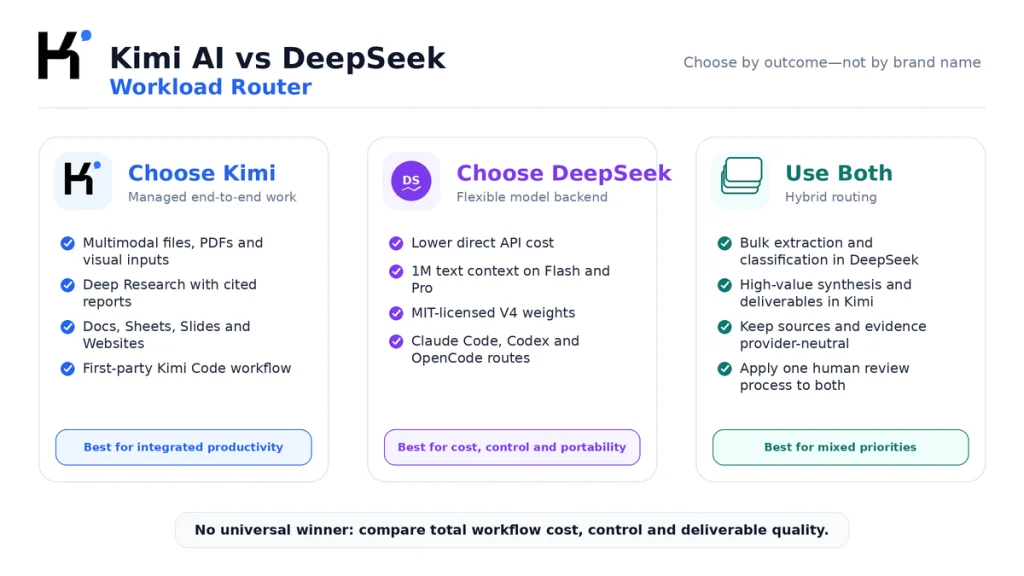
These are workload recommendations, not absolute capability rankings. A lower-priced model may outperform a more expensive one on a narrow task, and an integrated product may be less suitable than a custom pipeline when strict engineering control is required.
What Are You Actually Comparing?
“Kimi vs DeepSeek” can refer to at least six different comparisons. Mixing them produces misleading conclusions.
| Layer | Kimi | DeepSeek |
|---|---|---|
| Consumer assistant | Kimi web and mobile app with Chat, Agent, files, search, and workspaces. | DeepSeek web and mobile app with chat, Deep-Think, web search, and file text extraction. |
| Flagship hosted model | kimi-k3 | deepseek-v4-pro |
| Lower-cost general model | kimi-k2.6 | deepseek-v4-flash |
| Coding-focused model or product | Kimi K2.7 Code and Kimi Code | DeepSeek V4 with Harness and third-party coding integrations |
| Managed research product | Kimi Deep Research | Web search, Deep-Think, and custom Agent or API research pipelines |
| Open-weight deployment | K3, K2.7 Code, K2.6, and earlier Kimi weights under model-specific licenses | V4 Pro and V4 Flash weights under MIT |
A consumer user deciding which website to open has a different question from an engineer choosing an API, a developer selecting a terminal agent, or an infrastructure team evaluating self-hosted weights. This comparison keeps those layers separate.
The Three-Arena Scorecard
| Arena | Kimi advantage | DeepSeek advantage | What the evidence does not prove |
|---|---|---|---|
| Models and API | Native visual flagship, integrated Agent features, and a broader managed product layer. | Lower direct prices, 1M context across both V4 text tiers, dual OpenAI and Anthropic API formats, and MIT weights. | That one model will be more accurate on every prompt. |
| Coding | A cohesive first-party CLI and membership product with planning and approval workflows. | A flexible backend for multiple coding agents, lower token cost, and a plugin-oriented Harness. | A universal coding winner across repositories, languages, and harnesses. |
| Research and deliverables | A dedicated Deep Research workflow plus Docs, Sheets, Slides, Websites, and Agent execution. | Economical search-and-reasoning components for custom research systems. | That a normal web-search response equals a verified research report. |
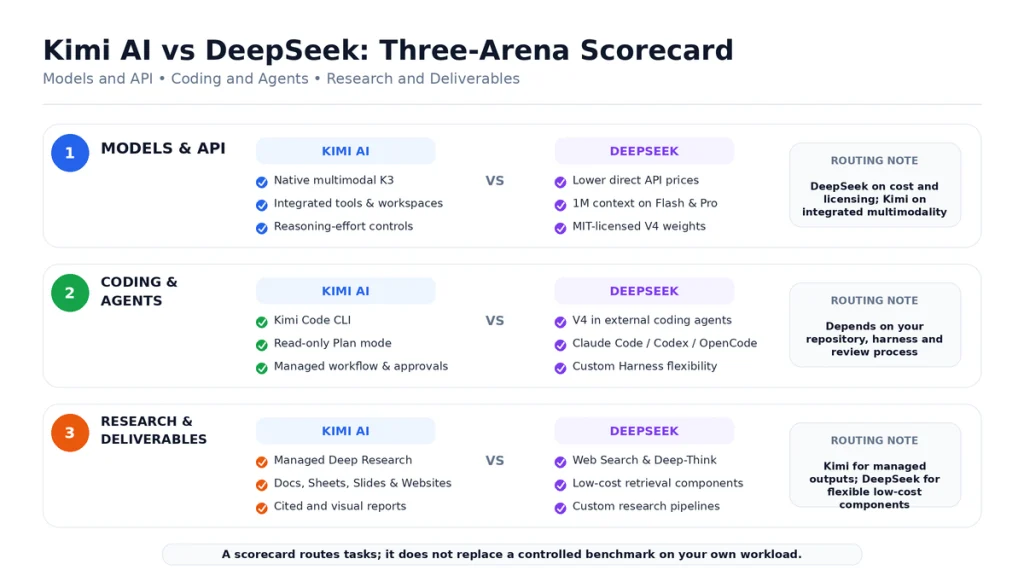
The remaining sections explain the evidence behind each routing decision.
Arena 1: Models, Context, and Multimodality
Current Kimi Models
| Model | Position | Published context | Thinking | Weights and license |
|---|---|---|---|---|
kimi-k3 | Flagship for long-horizon coding, native visual work, reasoning, and end-to-end knowledge tasks. | 1,048,576 tokens | Always enabled; low, high, or max effort. | 2.8T total / 104B activated; Kimi K3 License. |
kimi-k2.7-code | Coding-focused Agent model for long software-engineering workflows. | 262,144 tokens | Thinking and preserved-thinking workflow. | 1T total / 32B activated; Modified MIT. |
kimi-k2.7-code-highspeed | The same K2.7 Code model served at higher output speed. | 262,144 tokens | Same coding model behavior, with a faster serving tier. | Same underlying model; higher direct API price. |
kimi-k2.6 | General-purpose conversation, code, visual understanding, and Agent tasks. | 262,144-token API context | Thinking can be enabled or disabled. | 1T total / 32B activated; Modified MIT. |
Kimi’s consumer model selector does not map perfectly to API specifications. K2.6 Chat is documented at roughly 128K in a single turn, while K3’s extra-long 1M Chat capacity is a higher-tier membership benefit. The API version of K3 publishes a 1M maximum context independently of consumer membership.
Current DeepSeek Models
| API model | Current hosted version | Published context | Maximum output | Weights and license |
|---|---|---|---|---|
deepseek-v4-pro | DeepSeek-V4-Pro-0813 | 1M tokens | 384K tokens | V4 Pro repository: 1.6T total / 49B activated; MIT. |
deepseek-v4-flash | DeepSeek-V4-Flash-0731 | 1M tokens | 384K tokens | V4 Flash repository: 284B total / 13B activated; MIT. |
deepseek-v4-flash-vision-exp | DeepSeek-V4-Flash-Vision-Exp | 1M tokens | 384K tokens | Experimental image-input service based on the Flash tier. |
The old API names deepseek-chat and deepseek-reasoner were retired in July 2026. New integrations should use the current V4 model IDs rather than building around legacy aliases.
Context Window: The Old Kimi Advantage Has Narrowed
Kimi historically gained attention for long-document processing. That positioning remains relevant at the product level, but a simple specification claim that “Kimi has a longer context than DeepSeek” is no longer accurate for the flagship APIs.
- Kimi K3 API: up to 1M tokens.
- DeepSeek V4 Flash: 1M tokens.
- DeepSeek V4 Pro: 1M tokens.
- Kimi K2.7 Code and K2.6 API: 256K tokens.
A maximum context value does not guarantee perfect retrieval from a million-token prompt. Long-document quality also depends on document structure, tokenization, tool preprocessing, prompt design, output budget, and whether the evidence appears near the beginning, middle, or end. Test retrieval and citation accuracy on representative material.
Thinking and Tool Use
Kimi K3 always reasons and exposes three reasoning-effort settings. DeepSeek V4 Pro and Flash support both thinking and non-thinking modes, with thinking currently enabled by default and low, high, and max effort controls.
Both ecosystems support tool-oriented workflows, but the packaging differs:
- Kimi connects K3 to its Agent, Agent Cluster, Docs, Sheets, Slides, Websites, Deep Research, Work, Code, and custom tools.
- DeepSeek exposes Tool Calls, JSON output, Responses API, Anthropic API compatibility, and integrations with external Agent frameworks.
- Kimi K3 supports constrained tool choice and dynamic tool loading through its current API.
- DeepSeek V4 exposes a maximum output of 384K, which can be useful for unusually long generated artifacts but should still be bounded to control cost and review effort.
Vision, Files, and Multimodality
Kimi currently has the more established integrated multimodal workflow. K3 is positioned as a native visual model, and the wider Kimi product can work with images, videos, PDFs, Word documents, spreadsheets, presentations, and visual website tasks.
DeepSeek’s standard V4 Pro and Flash API routes remain text models in the current pricing table. The newer deepseek-v4-flash-vision-exp adds image input but is explicitly experimental. DeepSeek’s consumer app can upload files for text extraction, which should not be treated as identical to a documented office-document production suite.
Choose Kimi when screenshots, charts, visual documents, and editable office outputs belong to one workflow. Consider DeepSeek Vision Exp for an experimental image-enabled API where Flash-level pricing and DeepSeek compatibility matter, but validate it before production use.
Arena 2: Coding and Agent Workflows
There is no defensible universal answer to “Is Kimi or DeepSeek better for coding?” Coding performance depends on the model, harness, repository, tool permissions, tests, reasoning effort, context construction, and completion criteria.
What Kimi Code Provides
Kimi Code is a Moonshot-managed coding product rather than only an API model. Its current CLI can:
- Read and modify repository files.
- Search filenames and source content.
- Run shell commands, builds, and tests.
- Fetch relevant web pages.
- Plan and revise multi-step work.
- Create an
AGENTS.mdproject guide with/init. - Maintain sessions and local records.
- Request confirmation before modifying files or running commands under the default workflow.
Plan mode restricts the Agent to read-only tools while it explores the repository and prepares an implementation plan. The user can approve, reject, or revise the plan before coding begins. This is valuable when avoiding an incorrect architectural direction matters more than obtaining the first patch quickly.
Kimi Code can use Moonshot’s coding-oriented models and K3. Kimi’s K3 model card specifically recommends Kimi Code CLI as the preferred Agent framework for the flagship model. Kimi also documents support for selected third-party coding agents, including Claude Code and Roo Code.
The current VS Code situation needs a caveat: Kimi’s documentation says new installation of the extension is still limited to users of the legacy Python CLI, while existing users can continue after upgrading. Users of the newer TypeScript CLI should check the live compatibility notice before choosing the extension as a required workflow component.
What DeepSeek Provides for Coding
DeepSeek takes a more backend-oriented approach. The official API documentation provides configuration paths for tools such as Claude Code, Codex, OpenCode, OpenClaw, and other coding agents. Both the OpenAI-style and Anthropic-style endpoints reduce the amount of adaptation required for an existing toolchain.
DeepSeek Harness is currently in Developer Preview. Its architecture is plugin-oriented: the model adapter, tool registry, session log, Agent loop, persistence, interface, and related components can be replaced or extended through configuration. That is attractive for teams building their own Agent platform, but it requires more engineering ownership than using a fully managed coding product.
DeepSeek also documents an integration with Deep Code, an open-source terminal coding agent, and supports web search inside its Claude Code route. These integrations should be evaluated individually because the model provider, Agent tool, permissions, storage, and session behavior are separate layers.
Coding Workflow Router
| Coding scenario | Better starting route | Reason |
|---|---|---|
| You want one maintained CLI with plan approval and membership access | Kimi Code | The model, CLI, plan workflow, and subscription benefit are designed as one product. |
| You already use Claude Code, Codex, or OpenCode | DeepSeek V4 or Kimi Code API route | Both can integrate with external agents; DeepSeek currently documents a broader list and dual API formats. |
| You need the lowest token cost for many repository calls | DeepSeek V4 Flash | Its direct input and output rates are substantially lower. |
| You need native visual input during coding | Kimi K3 or K2.7 Code | Kimi’s current coding models include visual capabilities; DeepSeek’s vision route remains experimental. |
| You need a one-million-token coding context | Kimi K3 or DeepSeek V4 | Both flagship routes publish 1M context; test repository retrieval rather than choosing by the number alone. |
| You need a customizable open Agent harness | DeepSeek Harness | Its plugin-based preview targets developers building or extending an Agent runtime. |
| You need a coding-specialized open-weight Kimi model | Kimi K2.7 Code | It is purpose-built for long-horizon software-engineering workflows and uses Modified MIT. |
Do not choose a coding model from vendor benchmark tables alone. Harness choice can materially change the result. Build an evaluation from your own repositories, issue types, test suites, languages, dependency policies, and security requirements.
Arena 3: Research, Files, and Finished Deliverables
Kimi Deep Research
Kimi provides a dedicated Deep Research workspace powered by a research Agent. The documented workflow includes clarification, planning, active search, iterative reasoning, tool use, source filtering, and report generation.
A completed task can produce:
- A long-form text report with inline, traceable citations.
- A visual HTML report with structured layouts and interactive elements.
- Download routes for Word or PDF.
- A shareable visual-report link.
Kimi lists industry research, competitive analysis, due diligence, academic literature review, policy analysis, and personal purchasing decisions among the intended use cases. The task normally runs asynchronously and can take longer than standard chat.
This does not guarantee that every cited source is authoritative or every conclusion is correct. A managed research pipeline still needs source-level review, date checks, scope controls, and separation between evidence and inference.
DeepSeek Search and Deep-Think
DeepSeek’s consumer app provides web search, Deep-Think, and file upload with text extraction. Its API and documented coding integrations also support search-led Agent workflows. This is enough to perform useful current-information research and build custom retrieval pipelines.
However, the official materials reviewed for this comparison do not establish a separate DeepSeek product that matches Kimi Deep Research’s managed clarification-to-report workflow, visual report, and office-export path. DeepSeek supplies strong reasoning and retrieval components; the developer or user may need to design more of the research process and final-deliverable layer.
Documents, Spreadsheets, Slides, and Websites
Kimi’s strongest product-level distinction is what happens after the answer. Kimi can route verified content into:
- Docs: reports, proposals, document editing, PDF or Word transformation, and version comparison.
- Sheets: data extraction, formulas, pivot tables, charts, and downloadable XLSX files.
- Slides: editable presentation generation from prompts or source documents.
- Websites: generated and publishable web projects.
- Kimi Work: authorized workflows across local folders, files, applications, and browser tasks.
DeepSeek can generate the text, code, formulas, analysis, and structured data needed for these outputs, but the official consumer product is more chat-centered. Producing a polished Office file or site usually requires an external application, an Agent integration, or a custom workflow.
Choose Kimi when the final deliverable matters as much as the answer. Choose DeepSeek when you already own the surrounding application stack and need an economical reasoning engine inside it.
Kimi API vs DeepSeek API Pricing
The following prices are for the providers’ direct APIs, per one million tokens, as of the verification date. They should not be replaced with OpenRouter, cloud-host, or reseller prices without clearly labeling the alternative route.
| Model | Cache-hit input | Cache-miss input | Output | Context |
|---|---|---|---|---|
| Kimi K3 | $0.30 | $3.00 | $15.00 | 1,048,576 |
| Kimi K2.7 Code | $0.19 | $0.95 | $4.00 | 262,144 |
| Kimi K2.7 Code HighSpeed | $0.38 | $1.90 | $8.00 | 262,144 |
| Kimi K2.6 | $0.16 | $0.95 | $4.00 | 262,144 |
| DeepSeek V4 Flash — off-peak | $0.007 | $0.22 | $0.66 | 1M |
| DeepSeek V4 Flash — peak | $0.014 | $0.44 | $1.32 | 1M |
| DeepSeek V4 Pro — off-peak | $0.022 | $0.66 | $1.98 | 1M |
| DeepSeek V4 Pro — peak | $0.044 | $1.32 | $3.96 | 1M |
| DeepSeek V4 Flash Vision Exp | Same as Flash | Same as Flash | Same as Flash | 1M |
DeepSeek peak hours are currently 01:00–04:00 and 06:00–10:00 UTC from Monday through Friday. All other hours use off-peak rates. Images sent to Vision Exp are converted to input tokens according to their dimensions.
Kimi additionally publishes a $0.004 fee for each Web Search invocation, separate from model-token consumption. Check the live documentation because Kimi has also posted notices that parts of its API web-search documentation are being updated.
Worked Cost Example
Suppose one request uses one million uncached input tokens and produces 100,000 output tokens:
| Route | Estimated direct model cost |
|---|---|
| Kimi K3 | $4.50 |
| Kimi K2.7 Code | $1.35 |
| Kimi K2.6 | $1.35 |
| DeepSeek V4 Flash — off-peak | $0.286 |
| DeepSeek V4 Flash — peak | $0.572 |
| DeepSeek V4 Pro — off-peak | $0.858 |
| DeepSeek V4 Pro — peak | $1.716 |
This is a billing illustration, not an equal-quality comparison. It excludes cache hits, retries, tool loops, search calls, image tokens, taxes, storage, third-party markups, and Agent overhead. A cheaper request that needs repeated corrections may cost more at the workflow level than a successful higher-priced request.
Use our Kimi API pricing guide for a deeper explanation of Moonshot Direct API costs, caching, and tool fees.
Open Weights, Licenses, and Self-Hosting
Both companies publish major model weights, but “open weights” does not mean identical legal terms or easy local deployment.
| Model | Published weight license | Deployment consideration |
|---|---|---|
| Kimi K3 | Kimi K3 License | Read the custom terms before redistribution, modification, or commercial deployment. |
| Kimi K2.7 Code | Modified MIT | More permissive than K3’s custom license, but review the modifications and third-party notices. |
| Kimi K2.6 | Modified MIT | Same need to review modified terms and dependencies. |
| DeepSeek V4 Pro | MIT | Clean permissive model-weight license, but the 1.6T model requires substantial serving infrastructure. |
| DeepSeek V4 Flash | MIT | Smaller than Pro and K3, but 284B total parameters still make it a large deployment. |
DeepSeek has the clearer license advantage when a legal or procurement team prefers standard MIT terms. Kimi provides a more differentiated choice: a very large K3 flagship under its own license and smaller 1T models under Modified MIT.
Do not describe either flagship as a normal laptop model. Quantization and community runtimes can reduce the hardware requirement, but full-quality, high-context, multi-user serving remains an infrastructure project involving memory, accelerators, networking, storage, inference software, monitoring, and security.
Also verify checkpoint parity. A hosted API alias may receive post-training updates after an initial weight release. Record the exact API model version or downloadable checkpoint used in any controlled evaluation.
Consumer Apps, Free Access, and Usage Limits
Kimi and DeepSeek both provide consumer access without requiring the user to build an API integration, but their product economics are different.
Kimi Consumer Access
- K2.6 in normal Chat is currently available without consuming Membership Credits.
- K3, Agent, Deep Research, Slides, Kimi Work, Kimi Code, Websites, and other advanced features can consume a shared membership pool.
- K3 extra-long 1M Chat capacity is currently tied to higher membership tiers.
- Kimi Code also has separate five-hour and weekly limits in addition to the shared pool.
- Consumer membership does not become Open Platform API balance.
DeepSeek Consumer Access
DeepSeek’s official app announcement describes the consumer application as free, without advertisements or in-app purchases, and includes web search, Deep-Think, cross-platform history, and file text extraction. The later V4 Pro release states that the updated model is available through the app and web as well as the API.
Free access should not be interpreted as guaranteed unrestricted capacity. Service load, account controls, feature rollout, rate limits, and regional availability can change. Check the live interface rather than relying on an older screenshot or review.
Privacy and Data Governance
Do not select a provider for confidential work from model quality and price alone. Compare the exact deployment route:
- Consumer chat
- Direct API
- Enterprise workspace
- Third-party model provider
- Self-hosted weights
- Coding Agent and its local logs
Kimi’s current international consumer policy says User Content can be used to provide and improve the service, including model training. Kimi’s direct API documentation separately states that API input and output are not used to train or improve Kimi models.
DeepSeek publishes separate privacy and Open Platform terms. Review the current policy applying to the exact consumer, API, or downstream application being used. The fact that an API endpoint is stateless does not automatically establish every logging, abuse-prevention, billing, or retention detail outside that endpoint.
Self-hosting can change where inference data travels, but it transfers responsibility to the operator. The organization must secure prompts, logs, model servers, storage, credentials, backups, telemetry, and user access.
For Kimi-specific consumer, API, account, and file-handling details, see our Is Kimi AI Safe? guide.
Workload Router: Choose Kimi, DeepSeek, or Both
| Workload | Recommended starting point | Reason |
|---|---|---|
| Everyday questions and rewriting | Try Kimi K2.6 and DeepSeek | Both offer accessible consumer chat; judge tone, speed, and reliability on your own language and subject. |
| Multimodal report from PDFs, screenshots, and video | Kimi K3 | Native visual understanding and a direct route to Docs, Sheets, Slides, and Agent deliverables. |
| Large text-only API workload with strict cost target | DeepSeek V4 Flash | One-million-token context and the lowest current direct prices in this comparison. |
| Higher-tier DeepSeek reasoning and Agent work | DeepSeek V4 Pro | Stronger hosted tier with 1M context and improved Agent capabilities. |
| Managed competitive or market research | Kimi Deep Research | Dedicated clarification, search, report, citation, and visual-deliverable pipeline. |
| Custom high-volume research application | DeepSeek API or a mixed stack | Low token cost makes iterative retrieval and processing economical; you control the pipeline. |
| Editable Word, Excel, and PowerPoint outputs | Kimi | Dedicated Docs, Sheets, and Slides workspaces. |
| Terminal coding with a maintained first-party workflow | Kimi Code | CLI, read-only planning, approvals, project context, and membership integration. |
| Existing Claude Code, Codex, or OpenCode setup | DeepSeek or Kimi, tested side by side | Both can enter external tools; DeepSeek currently offers broader documented compatibility and lower direct price. |
| MIT-licensed self-hosting | DeepSeek V4 | V4 weights use standard MIT terms. |
| Open-weight multimodal flagship experimentation | Kimi K3 | K3 publishes full multimodal flagship weights, subject to the Kimi K3 License. |
| Large parallel managed Agent task | Kimi K3 Cluster or Agent Cluster | Kimi provides a managed parallel execution layer rather than requiring the user to build one. |
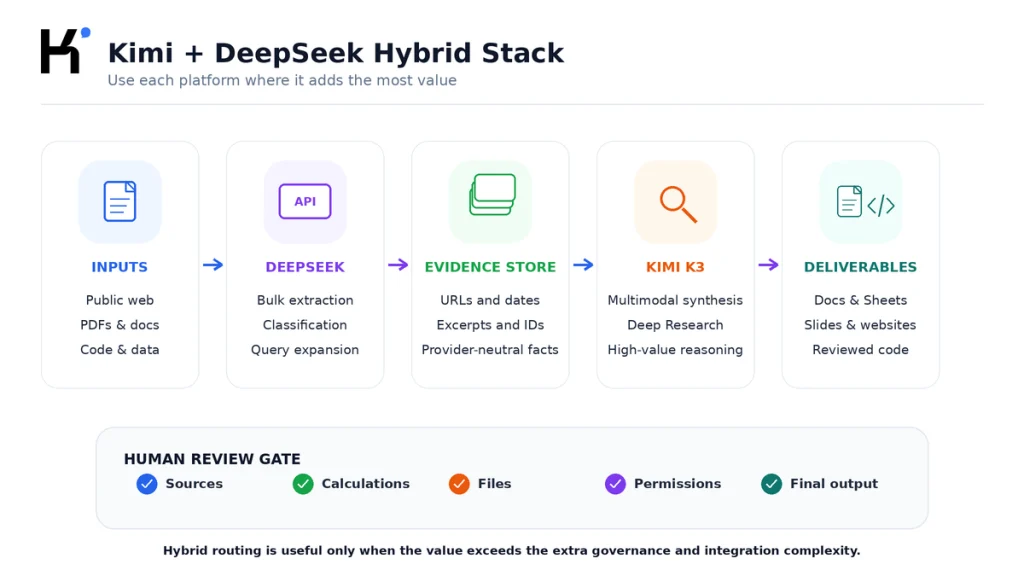
How to Build a Hybrid Kimi and DeepSeek Stack
Using both providers can be more rational than forcing every task through one model.
Example Hybrid Research Stack
- Use DeepSeek V4 Flash for inexpensive classification, deduplication, query expansion, and first-pass summaries.
- Keep primary-source URLs, dates, and extracted evidence in a provider-neutral database.
- Route visually complex material or high-value synthesis to Kimi K3.
- Use Kimi Deep Research when the project needs a managed research report rather than a custom pipeline.
- Create the final report, spreadsheet, or presentation in the relevant Kimi workspace.
- Run an independent human review against the stored evidence.
Example Hybrid Coding Stack
- Use DeepSeek V4 Flash for bulk repository indexing, low-risk explanations, and repetitive code transformations.
- Use DeepSeek V4 Pro or Kimi K2.7 Code for more difficult implementation tasks.
- Route visually informed frontend or multimodal debugging tasks to Kimi K3 where appropriate.
- Use the same test suite, lint rules, security scans, and acceptance criteria regardless of provider.
- Log the provider, model version, reasoning effort, tool configuration, and cost for every evaluated task.
A hybrid stack increases governance complexity. Data may be transmitted to two providers instead of one, credentials multiply, observability becomes harder, and output formats may differ. Use routing only when the operational benefit justifies the additional control surface.
How to Test Both Before Migrating
Do not migrate from DeepSeek to Kimi—or from Kimi to DeepSeek—after one impressive answer. Build a small evaluation set from actual work.
- Select representative tasks. Include common, difficult, long-context, tool-heavy, and failure-sensitive examples.
- Freeze the input. Use the same source files, system instructions, available tools, and acceptance criteria.
- Record the exact route. Note model ID, hosted version, provider, reasoning effort, context length, Agent harness, and date.
- Separate model and product comparisons. A Kimi Docs result should not be scored as if it came from a bare DeepSeek Chat Completion.
- Use objective checks. Unit tests, exact extraction, source support, calculations, schema validation, and human review are stronger than preference alone.
- Measure total workflow cost. Include retries, tool calls, human correction time, latency, failed outputs, and formatting work.
- Repeat unstable tasks. One successful run does not establish reliability.
- Inspect failures. Classify them as source retrieval, reasoning, tool execution, formatting, or policy failures.
- Run a privacy review. Confirm which provider and product receives each data category.
- Make a reversible decision. Keep model routing configurable instead of embedding one provider throughout the application.
A valid evaluation can conclude that one provider is better for one part of the workflow and worse for another. That is more useful than compressing multiple products into one overall score.
What This Comparison Cannot Prove
- It does not prove that Kimi or DeepSeek will win on your private dataset.
- It does not provide a synchronized cross-provider benchmark.
- Vendor benchmark results may use different harnesses, reasoning budgets, hardware, prompts, or task versions.
- Model size does not directly determine output quality.
- A 1M context window does not guarantee complete retrieval from every long input.
- Lower API price does not guarantee lower end-to-end project cost.
- Open weights do not guarantee easy, secure, or inexpensive deployment.
- MIT, Modified MIT, and the Kimi K3 License are not interchangeable.
- A managed research report is not automatically accurate because it contains citations.
- An experimental vision model should not be treated as a production guarantee.
- Consumer-chat availability does not establish API availability, and a subscription does not create interchangeable API credit.
Frequently Asked Questions
Is Kimi AI better than DeepSeek?
Not universally. Kimi is usually the stronger starting point for integrated multimodal research, Agent workflows, and editable documents, spreadsheets, presentations, or websites. DeepSeek is usually the stronger starting point for low direct API cost, MIT-licensed V4 weights, and flexible integration with existing Agent and coding tools.
Is Kimi AI a DeepSeek alternative?
Yes, but it is not a one-to-one replacement. Kimi can replace DeepSeek for chat, reasoning, coding, long-context analysis, API calls, and open-weight deployment. It also adds managed productivity features that DeepSeek does not package in the same way. DeepSeek may remain preferable when cost, MIT licensing, or backend flexibility is the priority.
Which is better for coding, Kimi or DeepSeek?
Kimi Code is attractive when you want a first-party CLI, read-only Plan mode, approval controls, and Kimi model integration. DeepSeek is attractive when you want a low-cost V4 backend inside Claude Code, Codex, OpenCode, DeepSeek Harness, or another Agent. Run both against your repositories and test suites before naming a winner.
Is Kimi K3 better than DeepSeek V4 Pro?
Kimi K3 has native visual capabilities, a 2.8T/104B MoE architecture, a 1M context, and deep integration with Kimi’s Agent products. DeepSeek V4 Pro also has a 1M context, costs less through the direct API, supports thinking and non-thinking modes, and publishes V4 weights under MIT. The better choice depends on modality, workflow, cost, license, and measured task performance.
Which has the larger context window?
Kimi K3, DeepSeek V4 Pro, and DeepSeek V4 Flash all publish a maximum context of approximately one million tokens. Kimi K2.6 and K2.7 Code publish 256K API contexts. Consumer-app access can have separate plan or interface limits.
Which API is cheaper?
DeepSeek’s direct V4 API is currently cheaper than Kimi’s comparable direct model routes, particularly V4 Flash during off-peak hours. Compare total workflow cost rather than tokens alone because retries, tools, search, latency, and human correction can alter the result.
Which is better for research?
Kimi is the clearer choice for a managed research workflow because it provides Deep Research, cited text reports, visual reports, and direct routes into Docs, Sheets, and Slides. DeepSeek is useful for web search and reasoning and may be more economical when a developer is building a custom research pipeline.
Does DeepSeek have an equivalent to Kimi Deep Research?
DeepSeek provides web search, Deep-Think, file text extraction, tool calls, and Agent integrations. The official documentation reviewed for this article does not establish a standalone managed product with the same clarification, long-form cited report, visual report, and export flow as Kimi Deep Research.
Which is better for PDF files?
Kimi currently offers the more complete consumer PDF workflow through K3, normal chat, Docs, Sheets, Slides, Work, and Skills. DeepSeek’s consumer app supports file upload and text extraction. For evidence-led PDF analysis, follow our Kimi PDF analysis guide.
Can Kimi and DeepSeek both be self-hosted?
Both publish major model weights that can be deployed outside their hosted APIs. DeepSeek V4 uses MIT. Kimi K3 uses the Kimi K3 License, while Kimi K2.6 and K2.7 Code use Modified MIT. The models are large and require serious infrastructure for practical high-context serving.
Can I use Kimi and DeepSeek together?
Yes. A common design is to use DeepSeek Flash for inexpensive bulk processing and Kimi K3 or Kimi workspaces for multimodal synthesis and finished deliverables. Keep evidence provider-neutral and account for the additional privacy, credential, observability, and routing complexity.
Are Kimi Membership and DeepSeek API costs directly comparable?
No. Kimi Membership is a consumer and productivity subscription with shared credits, while Kimi Open Platform and DeepSeek API are token-billed developer services. Compare subscription workflows separately from direct API workloads.
Official Sources and Update Methodology
This comparison was last verified on August 23, 2026. Official Kimi, Moonshot AI, DeepSeek, Hugging Face model cards, and provider documentation were used for model IDs, context windows, pricing, product capabilities, licenses, and integrations. Third-party comparisons were reviewed for search intent and content gaps but were not used as the authority for current specifications.
No synchronized model benchmark was conducted for this article. Vendor benchmark results were not converted into an overall winner because their harnesses, reasoning settings, task versions, and evaluation conditions can differ.
- Kimi Consumer Model and Mode Selection
- Kimi API Model Selection
- Kimi K3 Official Model Card and Weights
- Kimi K2.7 Code Official Model Card
- Kimi K3 Direct API Pricing
- Kimi K2.7 Code Direct API Pricing
- Kimi K2.6 Direct API Pricing
- Kimi Code CLI Getting Started
- Kimi Code Work Modes
- Kimi Deep Research Overview
- Kimi Docs and Sheets Overview
- Kimi Membership Overview
- Kimi API Data Processing and Security
- DeepSeek Models and Direct API Pricing
- DeepSeek API Quickstart and Current Model IDs
- DeepSeek API Change Log
- DeepSeek V4 Official Model Card and Weights
- DeepSeek V4 Flash Vision Experimental Release
- DeepSeek Harness Architecture
- DeepSeek Claude Code Integration
- Official DeepSeek Consumer App Announcement
- DeepSeek Privacy Policy
Recheck the official pricing and model pages before purchasing, deploying, or publishing a time-sensitive comparison. Hosted aliases, open-weight checkpoints, consumer products, and third-party providers may update on different schedules.
Last verified: August 23, 2026.