
Kimi AI has a free plan called Adagio. It is enough for K2.6 Chat and limited trials of agent features such as Deep Research and Kimi Work. Paid memberships start at $19 per month, or an effective $15 per month with annual billing, and mainly add more shared credits, faster queue priority, more concurrent agent tasks, Agent Swarm, Kimi Code, and higher feature limits. Allegretto adds Goal Mode and Kimi Claw, while Allegro and Vivace add K3 extra-long chat capacity of up to 1M tokens. For chat and occasional tasks, start free; pay only when recurring agent or coding work reaches the free limits.
This comparison covers the international USD membership documented on Kimi’s official international website. Prices, taxes, availability, and account-level limits may vary by region and can change.
Quick verdict: Adagio is the sensible choice for casual chat and testing. Moderato is the first practical paid tier for solo users who need Kimi Code or Agent Swarm. Allegretto is the stronger value tier when you need Goal Mode and Kimi Claw. Allegro is the first tier that unlocks K3 extra-long chat up to 1M tokens, while Vivace mainly buys a much larger monthly credit allowance rather than more concurrency.
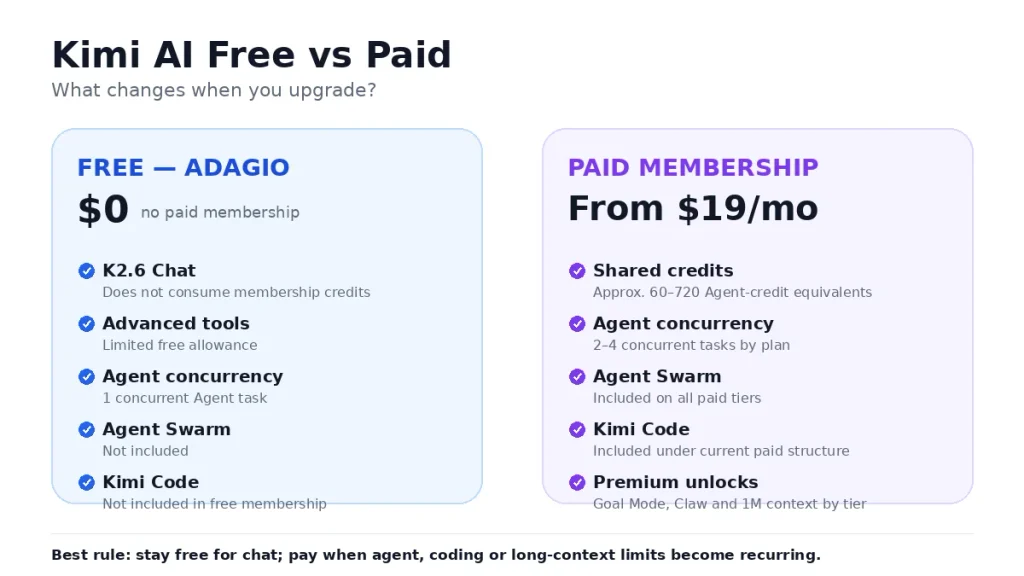
Kimi AI Free vs Paid at a Glance
| Plan | Monthly billing | Annual billing | Best suited to |
|---|---|---|---|
| Adagio | $0 | $0 | Chat, occasional research, and testing Kimi features |
| Moderato | $19/month | $180/year ($15 effective monthly) | Solo users beginning regular agent or coding work |
| Allegretto | $39/month | $372/year ($31 effective monthly) | Power users who need Goal Mode, Kimi Claw, and more credits |
| Allegro | $99/month | $948/year ($79 effective monthly) | Heavy workflows, four concurrent tasks, and K3 chat up to 1M tokens |
| Vivace | $199/month | $1,908/year ($159 effective monthly) | Very high monthly usage and the largest documented credit allowance |
Annual prices are paid annually. The effective monthly figure is shown only to make comparison easier.
Kimi’s official pricing details list four paid international plans. The free Adagio tier appears in Kimi’s official model pricing comparison. The signed-in subscription page remains the final source for the price, tax, and availability offered to your account.
Is Kimi AI Free?
Yes. Kimi AI can be used without a paid subscription through the Adagio plan. The most important free benefit is K2.6 Chat: Kimi’s official credit rules state that K2.6 in Chat is free for all users and does not consume membership credits. This makes the free plan useful for ordinary questions, writing, explanations, brainstorming, and other chat-based tasks.
The free plan is not the same as unrestricted access to every Kimi product. Advanced agent workflows draw from a limited allowance, and several premium capabilities are unavailable until you subscribe.
What the Kimi free plan includes
- K2.6 Chat without membership-credit consumption.
- Limited access to Kimi Deep Research. Kimi says the free plan includes a monthly allowance, measured by token consumption rather than a fixed number of research queries.
- Free access to the Kimi Work desktop app. New users receive limited trial credits, and free users can create up to two scheduled tasks.
- One concurrent Agent task.
- A limited allowance for trying agent-created slides, documents, spreadsheets, websites, research, and related workflows.
What the free plan does not include
- Agent priority queue
- Agent Swarm
- Kimi Code membership access
- Goal Mode
- Kimi Claw cloud deployment
- Database-backed website deployment
- K3 extra-long chat capacity up to 1M tokens
The free allowance is not published as a permanent fixed number of tasks. Consumption depends on how many tokens a task processes, so a short request and a long research project can use very different portions of the same allowance. Check the credit indicator in your Kimi account before assuming that a specific number of tasks is guaranteed.
What Does a Paid Kimi Subscription Add?
A paid Kimi subscription is primarily a capacity and workflow upgrade. It does not simply replace the free chatbot with a different chatbot. Paid plans provide a larger shared credit pool and unlock tools designed to complete multi-step work rather than only answer a prompt.
- More agent capacity: paid plans list approximately 60 to 720 Agent-credit equivalents per billing cycle, depending on tier.
- Faster task handling: every paid plan lists a 4× Agent priority queue.
- More concurrency: two concurrent Agent tasks on Moderato and Allegretto, or four on Allegro and Vivace.
- Agent Swarm: available across all four paid plans, with two, four, or eight concurrent subagents depending on tier.
- Kimi Code: currently included with every documented paid membership tier, subject to its own usage controls.
- Advanced workspace features: a customizable dashboard, more scheduled and widget tasks, larger project quotas, more storage, plugins, Dream Memory, and self-evolving skills.
- Tier-specific tools: Goal Mode and Kimi Claw begin with Allegretto, while K3 extra-long chat up to 1M tokens begins with Allegro.
The listed Agent-credit numbers are approximate equivalents based on typical token consumption, not a promise that every task costs exactly one credit. A complex Deep Research project can consume much more capacity than a short document or code request.
Kimi Subscription Plans Explained
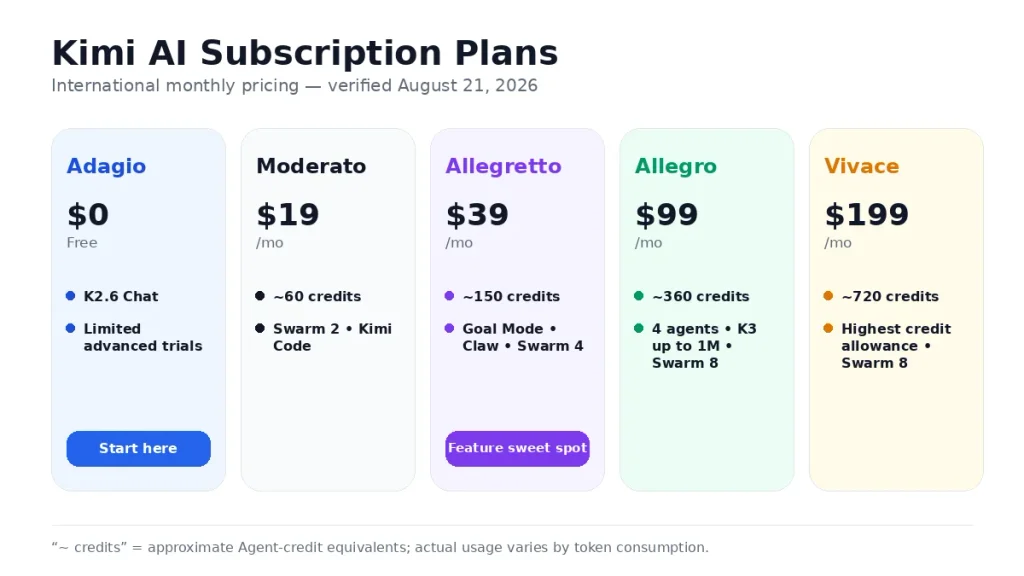
Adagio: the free Kimi plan
Price: $0.
Adagio is best for users who mainly need Kimi as a chat assistant or want to test agent features before paying. It provides one concurrent Agent task, no priority queue, no Agent Swarm, no Kimi Code membership, no Kimi Claw cloud deployment, and no database-backed website deployment. Kimi Work and Deep Research can still be tried with limited free capacity.
Choose Adagio when: your work is mostly chat, your advanced tasks are occasional, or you have not yet measured how often you will use Kimi’s agent tools.
Moderato: the entry paid plan
Price: $19 monthly, or $180 per year.
- Approximately 60 Agent-credit equivalents
- Two concurrent Agent tasks
- 4× Agent priority queue
- 10 scheduled tasks and 10 widget tasks
- 20 projects and 20GB of project storage
- Agent Swarm with two concurrent subagents
- Kimi Code access under the current membership structure
- 2,000 professional-database calls
- Database-backed website deployment
Moderato does not include Goal Mode, Kimi Claw, or K3 extra-long chat capacity up to 1M tokens. It is the most logical first upgrade for an individual who needs Agent Swarm or Kimi Code but does not yet need autonomous goals, Claw, or heavy monthly volume.
Allegretto: the feature-focused value tier
Price: $39 monthly, or $372 per year.
- Approximately 150 Agent-credit equivalents
- Two concurrent Agent tasks
- 4× Agent priority queue
- 15 scheduled tasks and 15 widget tasks
- 20 projects and 20GB of project storage
- Agent Swarm with four concurrent subagents
- Goal Mode
- Kimi Code access under the current membership structure
- Kimi Claw on web, Android, and PC
- Up to 10 Claw group chats
- 5,000 professional-database calls
Allegretto is where the feature set changes more meaningfully. It adds Goal Mode and Kimi Claw, more than doubles the approximate Agent capacity of Moderato, and doubles Swarm concurrency from two to four subagents. It still does not include K3 extra-long chat up to 1M tokens in the consumer workspace.
Choose Allegretto when: you regularly run research, coding, documents, slides, or automated workflows and specifically need Goal Mode or Kimi Claw.
Allegro: heavy agent work and 1M-token chat
Price: $99 monthly, or $948 per year.
- Approximately 360 Agent-credit equivalents
- Four concurrent Agent tasks
- 4× Agent priority queue
- K3 extra-long chat capacity up to 1M tokens
- 20 scheduled tasks and 20 widget tasks
- 100 projects and 50GB of project storage
- Agent Swarm with eight concurrent subagents
- Goal Mode, Kimi Code, and Kimi Claw
- Up to 10 Claw group chats
- 12,000 professional-database calls
Allegro is the first plan that raises Agent concurrency from two tasks to four and unlocks K3 extra-long chat capacity up to 1M tokens. This makes it the relevant tier for large codebases, very long document collections, and users who frequently keep several agent workflows running at once.
Vivace: maximum documented personal-plan capacity
Price: $199 monthly, or $1,908 per year.
- Approximately 720 Agent-credit equivalents
- Four concurrent Agent tasks
- 4× Agent priority queue
- K3 extra-long chat capacity up to 1M tokens
- 25 scheduled tasks and 25 widget tasks
- 100 projects and 50GB of project storage
- Agent Swarm with eight concurrent subagents
- Goal Mode, Kimi Code, and Kimi Claw
- Up to 10 Claw group chats
- 24,000 professional-database calls
Vivace doubles Allegro’s approximate Agent-credit allowance and professional-database calls, but it does not increase the published limits for concurrent Agent tasks, Swarm subagents, projects, storage, or K3 extra-long chat. The upgrade therefore makes the most sense when monthly consumption—not missing functionality—is the main problem.
Detailed Kimi Free vs Paid Feature Comparison
| Feature or limit | Adagio | Moderato | Allegretto | Allegro | Vivace |
|---|---|---|---|---|---|
| Monthly price | $0 | $19 | $39 | $99 | $199 |
| Annual total | $0 | $180 | $372 | $948 | $1,908 |
| Approx. Agent-credit equivalent | Limited allowance; no fixed public number | 60 | 150 | 360 | 720 |
| Concurrent Agent tasks | 1 | 2 | 2 | 4 | 4 |
| Agent priority queue | No | 4× | 4× | 4× | 4× |
| K3 extra-long chat up to 1M tokens | No | No | No | Yes | Yes |
| Scheduled tasks | Up to 2 in Kimi Work | 10 | 15 | 20 | 25 |
| Widget tasks | Not publicly specified | 10 | 15 | 20 | 25 |
| Projects | Not publicly specified | 20 | 20 | 100 | 100 |
| Project storage | Not publicly specified | 20GB | 20GB | 50GB | 50GB |
| Plugins | Not publicly specified | 15+ types | 15+ types | 15+ types | 15+ types |
| Agent Swarm | No | Yes | Yes | Yes | Yes |
| Concurrent Swarm subagents | No | 2 | 4 | 8 | 8 |
| Goal Mode | No | No | Yes | Yes | Yes |
| Kimi Code | No membership access | Available | Available | Available | Available |
| Kimi Claw cloud deployment | No | No | Yes | Yes | Yes |
| Claw group chats | No | No | 10 | 10 | 10 |
| Professional-database calls | Not publicly specified | 2,000 | 5,000 | 12,000 | 24,000 |
| Deploy website with database | No | Yes | Yes | Yes | Yes |
Paid-plan credit figures are approximate equivalents based on typical task token consumption. Actual usage and UI-displayed limits prevail.
How Kimi Credits and Usage Limits Work
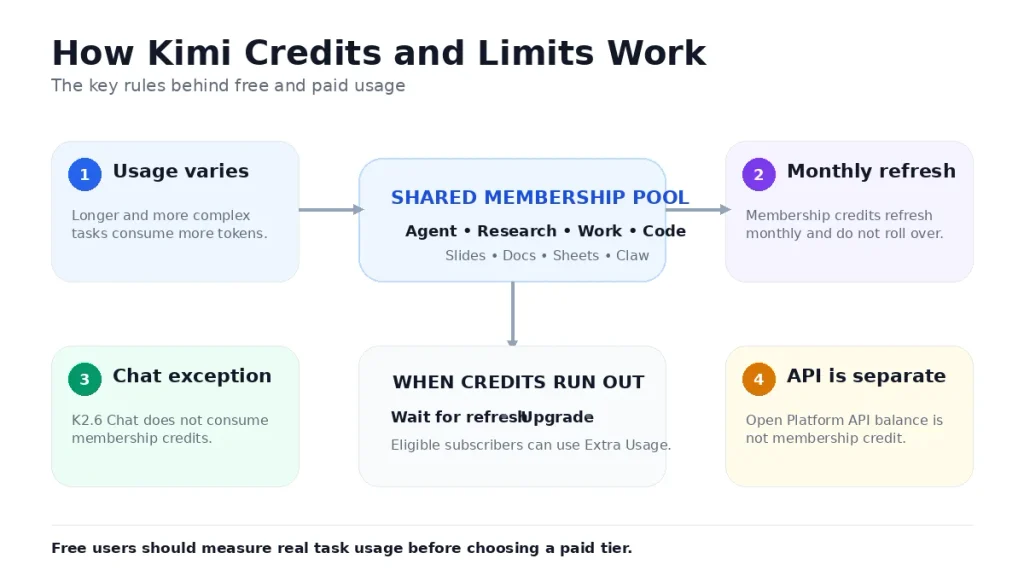
Most membership features share one credit pool
Agent tasks, Deep Research, Slides, Docs, Sheets, Kimi Work, Kimi Code, Kimi Claw, website deployment, and other membership features draw from one shared pool. Spending more on one feature leaves less capacity for the others. K2.6 Chat is the major exception: Kimi says it is free in Chat and does not consume membership credits.
Credits are based on token consumption, not a fixed task count
Longer prompts, uploaded context, tool calls, and longer outputs can consume more of the allowance. Kimi’s official rough guide for free-tier users estimates that a simple slide deck may use about 1–2% of the allowance, a Deep Research report about 5–10%, and a short code task about 0.5–2%. These are examples, not guaranteed prices for every request.
Credits refresh monthly and do not roll over
Both monthly and annual subscribers receive credits on a monthly cycle. The refresh occurs on the subscription anniversary rather than necessarily on the first day of the calendar month. Unused membership credits expire at the end of the cycle and do not roll over or convert to cash.
Kimi Code has additional limits
Kimi Code currently draws from the membership pool, but Kimi also applies separate five-hour and weekly usage controls to the coding product. Reaching a Kimi Code-specific limit does not automatically mean that every other Kimi membership feature is unavailable. Check the /usage command or your account interface for the limits and remaining capacity that apply to your account.
What happens when credits run out?
A task already in progress can finish, but new credit-consuming tasks show an insufficient-credit message. You can wait for the next refresh, upgrade to a higher tier, or—if you are already a subscriber—enable Extra Usage for pay-as-you-go overflow. Free users must subscribe before they can purchase Extra Usage.
Kimi currently lists a $10 minimum Extra Usage top-up. Subscription credits are used first, and overflow spending begins after those credits are exhausted or rate-limited. Extra Usage funds do not expire, although the feature, rates, and recharge limits can change.
Watch for ongoing cloud consumption: Kimi’s pricing FAQ says a deployed Kimi Claw cloud host consumes about 0.6% of membership credits per day, while a published Agent website can consume about 0.08% for cloud service. Delete an unused Claw host or unpublish an unused website to stop the corresponding ongoing deduction.
Which Kimi Plan Should You Choose?
| Your usage pattern | Recommended starting plan | Reason |
|---|---|---|
| Mostly chat, writing, explanations, and occasional research | Adagio | K2.6 Chat is free, and limited advanced-feature trials let you measure real demand before paying. |
| Occasional but recurring Agent, Swarm, or coding work | Moderato | It is the cheapest tier with Agent Swarm, Kimi Code, priority processing, and a meaningful monthly pool. |
| Regular professional workflows requiring Goal Mode or Kimi Claw | Allegretto | It adds the most important feature unlocks over Moderato and raises the approximate credit allowance to 150. |
| Large codebases, very long conversations, or several simultaneous tasks | Allegro | It unlocks K3 extra-long chat up to 1M tokens and increases Agent concurrency to four. |
| Allegro features are sufficient, but monthly credits repeatedly run out | Vivace | It doubles the approximate Agent-credit allowance and database-call quota without adding much new functionality. |
For standard chat and occasional file work
Stay on Adagio first. Paying is difficult to justify when K2.6 Chat covers the core task and your use of Deep Research, Slides, or Kimi Work remains occasional.
For regular research, presentations, documents, or spreadsheets
Moderato is a sensible entry point, but Allegretto may offer better practical value when you need Goal Mode, Kimi Claw, or more frequent agent execution. Track how much of your pool one typical report or deck consumes before committing annually.
For coding
All four currently documented paid memberships include Kimi Code, but the coding product has separate five-hour and weekly controls in addition to shared-credit consumption. Start with Moderato for light use. Move up only after your usage display shows that credits or coding-specific limits are becoming a repeated constraint.
For long-context K3 work
Choose Allegro or Vivace when you specifically need K3 extra-long chat capacity up to 1M tokens in the Kimi workspace. Do not pay for Allegro only because “1M tokens” sounds impressive; the upgrade is valuable when your actual codebase, document set, or conversation regularly exceeds lower-tier capacity.
For teams and managed business use
The personal Vivace plan is not automatically the best organizational choice. Kimi Business is a separate product with team-oriented purchasing and management. Organizations should compare business requirements, data controls, support, seat minimums, and API needs rather than treating the highest personal tier as an enterprise plan.
Kimi Subscription vs Kimi API: They Are Not the Same
A Kimi subscription is for using the Kimi workspace and membership features. The Kimi Open Platform API is a separate pay-as-you-go developer product. Membership benefits do not become Open Platform balance, and Open Platform top-ups cannot be used to buy a Kimi membership.
- Kimi Membership: monthly or annual access to consumer and professional workspace features.
- Kimi Code: a coding product currently included in paid membership, with its own keys, endpoints, and usage controls.
- Kimi Open Platform API: token-based programmatic access with a separate balance and API keys.
The keys and balances are not interchangeable. Buying Moderato, Allegretto, Allegro, or Vivace does not give you an equivalent dollar amount of general Open Platform API credit. Developers should review the official product and billing distinction before configuring an integration.
This article intentionally does not reproduce the full API token-price table. Membership comparison and API pricing are different search intents and should be evaluated separately.
Monthly vs Annual Kimi Subscription
Annual billing lowers the effective monthly cost of every paid tier:
- Moderato: save $48 per year
- Allegretto: save $96 per year
- Allegro: save $240 per year
- Vivace: save $480 per year
Annual payment does not mean receiving an entire year of credits at once. Kimi states that annual subscribers still receive and refresh membership credits on a monthly cycle, and unused credits do not roll over.
For a new user, monthly billing is usually the safer first step because token-based consumption is difficult to predict before running real workloads. Annual billing becomes more attractive after one or two cycles show that the plan consistently matches your needs.
Kimi allows users to cancel auto-renewal, with benefits remaining active through the end of the current paid period. Subscription management can differ when the purchase was made through Apple or Google Play.
Important Notes About Regions, Availability, and Future Plan Changes
This article uses the international USD pricing documented on Kimi’s international help center. Regional Kimi storefronts can show different currencies, plan names, prices, taxes, and payment options. Do not convert a regional price and present it as the official worldwide price.
Plan availability may also be account-dependent. Kimi published a July 20, 2026 notice stating that some new plan arrangements were not yet available for purchase because of computing-capacity constraints. A later official K3 pricing page dated August 12 lists the four USD plans and provides subscription links. The safest conclusion is that the documented plans are current, but the signed-in checkout determines whether a plan can be purchased by a particular account at a particular time.
Kimi’s help center also says a future membership system is planned in which general Kimi membership benefits and Kimi Code benefits will be sold separately. Under the current documented structure, Kimi Code is included in all four paid tiers and existing subscribers are described as unaffected. Recheck the official pricing and Kimi Code benefit pages before relying on this article for a purchase decision.
Is a Paid Kimi Subscription Worth It?
A paid Kimi subscription is worth considering when a specific workflow—not curiosity—requires it. The strongest reasons to upgrade are recurring Agent tasks, Agent Swarm, Kimi Code, faster queue priority, Goal Mode, Kimi Claw, greater concurrency, or K3 extra-long chat up to 1M tokens.
The free Adagio plan remains the better value when you mainly use ordinary chat and only occasionally test advanced features. A paid plan is also the wrong purchase when your real goal is building an application through the Kimi API, because API billing is separate.
For most first-time subscribers, Moderato is the lowest-risk upgrade. Allegretto offers the clearest feature jump because it adds Goal Mode and Kimi Claw. Allegro is justified by long-context and heavier parallel work. Vivace is primarily a capacity upgrade for users who already know that Allegro’s monthly pool is insufficient.
Frequently Asked Questions
Is Kimi AI completely free?
Kimi has a free Adagio plan, and K2.6 Chat does not consume membership credits. Advanced agent features have limited free capacity, while tools such as Agent Swarm, Kimi Code membership, Goal Mode, Kimi Claw cloud deployment, and K3 extra-long chat require an eligible paid plan.
What is the Kimi free plan called?
The free plan is called Adagio in Kimi’s international plan comparison.
How much does a Kimi subscription cost?
The documented international monthly prices are $19 for Moderato, $39 for Allegretto, $99 for Allegro, and $199 for Vivace. Annual billing costs $180, $372, $948, and $1,908 respectively, before applicable taxes.
Is Kimi Code free?
Kimi Code model usage is currently included with the documented paid membership tiers, not with Adagio. The software or client may be installable separately, but using Kimi’s hosted coding benefit requires an eligible membership or a separately billed product route. Kimi has announced plans to separate Kimi Code and general membership benefits in a future system.
Which Kimi plan includes Agent Swarm?
Agent Swarm is included in Moderato, Allegretto, Allegro, and Vivace. Their documented concurrent-subagent limits are two, four, eight, and eight respectively.
Which Kimi plan includes Goal Mode?
Goal Mode begins with Allegretto and is also included in Allegro and Vivace. It is not listed for Adagio or Moderato.
Which Kimi plan includes Kimi Claw?
Kimi Claw cloud deployment is listed for Allegretto, Allegro, and Vivace. It is not included in Adagio or Moderato.
Which plan includes K3 chat with up to 1M tokens?
K3 extra-long chat capacity up to 1M tokens is listed for Allegro and Vivace in the international membership comparison.
Do unused Kimi credits roll over?
No. Membership credits refresh on a monthly billing cycle and unused credits expire rather than rolling over. Extra Usage balance follows different rules and currently does not expire.
Does a Kimi subscription include API credits?
No. Kimi Membership, Kimi Code, and the Kimi Open Platform API have separate billing systems, balances, benefits, and keys. Membership benefits do not convert into general Open Platform API balance.
What happens when Kimi credits run out?
Tasks already running can finish, but new credit-consuming tasks display an insufficient-credit prompt. You can wait for the next refresh, upgrade, or use Extra Usage if you are an eligible subscriber.
Can I cancel a Kimi subscription?
Yes. Kimi says auto-renewal can be cancelled at any time, and paid benefits remain available until the end of the current billing period. Subscriptions purchased through Apple or Google Play must be managed through the relevant store.
Sources and Update Methodology
This comparison is based on Kimi’s official international documentation rather than third-party price estimates. The main sources reviewed were:
- Kimi Membership Pricing Details
- Kimi Membership Plans Overview
- Kimi Credit Update and Usage Rules
- Kimi K2.6 Pricing and Plan Comparison
- Kimi Deep Research
- Kimi Work Introduction
- Kimi Code Benefits
- Kimi API Product and Billing Distinction
- Kimi Membership Adjustment Notice
- Kimi Cancellation Instructions
Last verified: August 21, 2026.